


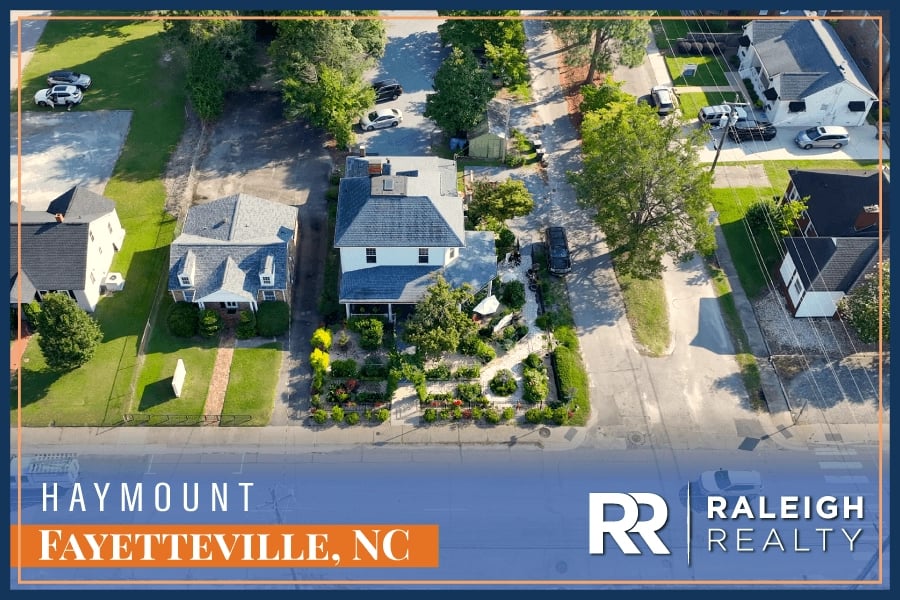
Haymount is the one Fayetteville neighborhood where the address you buy comes with a regulator attached. Homes inside the Haymount Local Historic District require a Certificate of Appropriateness from the Fayetteville Historic Resources Commission before an owner can replace a roof, swap windows, repaint the exterior in a materially different color, or add on. That single fact controls more of the Haymount buying decision than any listing photo suggests, and it is worth understanding before the first showing.
The neighborhood also features the city's oldest buildings, the widest range of architecture, and the shortest walk to downtown Fayetteville. Prices run from $250K for smaller bungalows to $900K+ for restored antebellum properties on Hillside Avenue, with the current 71-listing feed showing a median around $362K.
The Haymount Historic District was placed on the National Register of Historic Places in 1983, with a boundary increase along Bradford Avenue added in 2007. Being on the National Register is honorary. What actually restricts owners is the parallel Local Historic District designation, which gives the Fayetteville Historic Resources Commission authority to review and approve exterior changes visible from the public right-of-way.
The Certificate of Appropriateness process reviews any exterior alteration to a contributing property. That includes roofing materials and colors, window replacements, siding, exterior paint changes, additions, fencing, driveways, outbuildings, and demolition. Interior work is not reviewed. Minor changes matching in-kind materials receive staff-level approval within roughly 10 to 14 business days; anything visible from the street that changes the appearance goes to the Historic Resources Commission's monthly meeting. A denied COA cannot be appealed to a materials workaround; the appeal path is superior court.
The historic district boundary matters because it determines whether the COA rules apply to a specific address. The core district runs along Hale Street, Hillside Avenue, Athens Avenue, and Hay Street. The 2007 expansion covers 109-207 Bradford Avenue, 801-806 Arsenal Avenue, and 801 Hay Street. The four-lane Martin Luther King Freeway forms the western edge. Homes on parallel streets one or two blocks outside those boundaries carry a Haymount address and mailbox but are not inside the overlay. On any listing, verify the specific parcel against the city's historic-district map before assuming either way, because the practical difference between "in" and "out" shows up in every future renovation quote.
The COA process changes renovation economics in two directions. Both matter for buyers running numbers.
In-kind replacement is the standard the Historic Resources Commission enforces. That usually means slate or standing-seam metal roofs stay slate or standing-seam metal (a slate roof replacement lands around $25 to $40 per square foot compared to $5 to $8 for architectural shingle), wood windows are replaced with wood or aluminum-clad wood rather than vinyl, and lap siding matches the original width and profile. A typical historic-district roof, window, or siding project runs 20 to 40 percent above a comparable non-historic project. Buyers who underwrite a Haymount home assuming standard suburban renovation quotes will be short.
North Carolina layers a state historic rehabilitation credit on top of the federal program. Owner-occupied certified rehabilitations qualify for a 15 percent state credit on qualified expenditures; income-producing rehabilitations qualify for the 15 percent state credit stacked on the federal 20 percent, effectively covering 35 percent of qualified expenses. The work has to meet the Secretary of the Interior's Standards for Rehabilitation and be certified by the North Carolina State Historic Preservation Office. Buyers planning substantial work should model the credits into the purchase price, because they can offset most of the in-kind material premium.
Every Haymount address falls within 28305 and within Fayetteville city limits, which add the city rate to the Cumberland County rate for a combined rate near $1.30 per $100 of assessed value. Buyers relocating from unincorporated Cumberland County should adjust their tax expectations upward.
Contributing properties were built between 1817 and 1950, and the district represents almost every American residential style across that span. The oldest building is the Robert Strange Town House on Haymount Hill (c. 1817, Federal with a Palladian door surround); the Edgar Allan Poe House at 206 Bradford Avenue is an 1897 Queen Anne on its own National Register listing. Between those anchors, buyers will see:
Homes just outside the historic-district boundary tend to be newer post-1950 infill, mid-century ranches, and some 1970s and 1980s builds. Those addresses carry the Haymount name but not the design controls or the tax-credit access.
The commercial pocket sits at the intersection of Morganton Road, Fort Bragg Road, and Hay Street, roughly a mile west of downtown, and is one of the few Fayetteville neighborhoods with genuine walk-to amenities. Restaurants and cafes clustered in the neighborhood include the Haymount Truck Stop on Broadfoot Avenue, Rude Awakening Coffee House at 227 Hay Street (open since 1999), Latitude 35 at 1217 Hay Street, Belmont Village at 1104 Hay Street, and District House of Taps, the area's self-pour taproom. The Museum of the Cape Fear Historical Complex and the NC History Center on the Civil War, Emancipation and Reconstruction sit on the former U.S. Arsenal grounds at the top of Haymount Hill. The Cape Fear Regional Theatre at 1209 Hay Street is a short drive, and Cape Fear Botanical Garden is roughly ten minutes east.
Haymount belongs to Cumberland County Schools, with base assignments at Alma Easom Elementary or Vanstory Hills Elementary depending on the address, Max Abbott Middle School, and Terry Sanford High School. Terry Sanford is one of the district's older high schools and its footprint anchors the western edge of the greater Haymount study area. Verify the current zoned assignment for the specific address before making offers, because CCS boundary adjustments happen on a separate cycle from most families' expectations.
Fort Liberty is roughly 15 to 20 minutes north via the All-American Freeway and Bragg Boulevard, which keeps Haymount viable for military families who want a historic-district home rather than the newer inventory clustered north of Ramsey Street. Cape Fear Valley Medical Center sits directly on the north edge of Haymount, off Owen Drive, which is why the neighborhood has a high concentration of physician and nursing households.
For buyers still comparing sides of town, the Fayetteville parent search lays out the six major submarkets. Haymount overlaps with the top of the Fayetteville luxury feed for restored properties above $700K on Hillside or Hale, and the best-neighborhoods guide and moving-to-Fayetteville overview add wider context for buyers who need to sort other pockets alongside this one.
The most expensive mistake in this neighborhood is buying a home inside the local historic overlay while planning a renovation the Historic Resources Commission will not approve. That surfaces after closing, when the roof or window quote comes in and the contractor asks whether the COA has been filed. Three verifications save the trouble: pull the specific parcel against the Fayetteville historic-district map to confirm whether the address is inside the National Register district, the Local Historic District overlay, or both; if the address is inside the overlay, run any planned exterior work past the Historic Resources Commission staff to hear whether it is likely to receive staff approval or need a hearing; and for any home built before 1978 (nearly every contributing property here), budget lead-based paint disclosure and possible abatement into the renovation numbers.
Our team at Raleigh Realty runs the historic-district check on every Haymount showing as a matter of course, because the answer changes both the offer price and the renovation budget. Call our office at 919-249-8536 to walk through a specific address before the tour rather than after.